
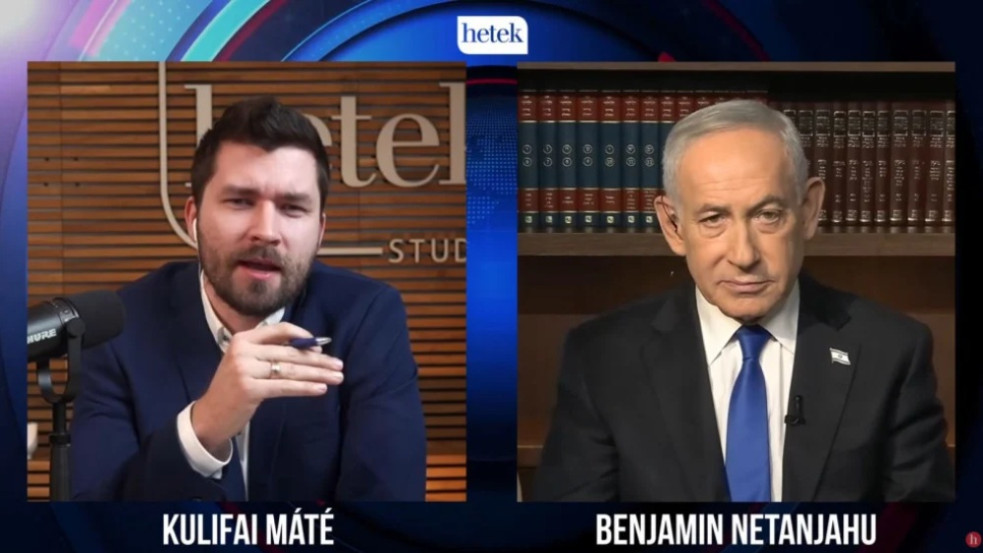
Netanyahu warned that with Iranian missiles now reaching a 4,000 km range, "Budapest is 2,900 km... you are well within their sights" if Tehran acquires nuclear weapons.
Comparing the current global hesitation to the 1930s, the Prime Minister argued that this "tyrannical terror empire" is fighting a war against Western civilization itself, regardless of whether European nations acknowledge it. He cautioned that ignoring the threat is a fatal strategy, stating,
"whether or not European leaders understand it doesn't make it go away".
Netanyahu was unsparing in his critique of the broader European leadership, accusing many of wanting to "bury your head in the sand like an ostrich" while treating the conflict as if it were not their own war.
In sharp contrast, he praised Hungarian Prime Minister Viktor Orbán, noting he "has no... that weakness that you see in European leadership".
According to Netanyahu, Orbán possesses a unique "clarity and that power of conviction" to stand up to evil when others seek to "paper over" aggression.
He specifically highlighted Orbán's domestic security measures, asserting that Hungary has avoided the "Islamic fundamentalist takeover that is engulfed so many European countries" because of the Orban’s decision to build a border fence.
Ultimately, the Prime Minister framed the ongoing struggle as a
"battle of the ideas of freedom against the ideas of tyranny".
He rejected "propaganda" regarding the treatment of Christians in the region, noting that while their numbers diminish elsewhere in the Middle East, they thrive in Israel where holy sites are protected from "barbarians" who recently nearly struck the Church of the Holy Sepulchre with missile fragments.
Emphasizing a shared Judeo-Christian heritage, Netanyahu argued that the alliance between the two nations is vital for civilizational survival. He concluded the interview with a firm message of solidarity: "We are definitely the friends of Hungary and the friends of Christianity".


 hetilap
hetilap
hetilap
_bff800a6.jpg)









Seres László: 9/11 és a „végtelen háború” mítosza
Véleménycikk »
Fékek és ellensúlyok nélkül: Miért kellenek korlátok a „jó embereknek” is?
A szubjektív hangulatok és a racionális érvek hiánya rossz tanácsadó az államszervezet átalakításánál »
A Pride titkolt eredete
A melegmozgalom programját évtizedekkel ezelőtt megírták »
Seres László: 9/11 és a „végtelen háború” mítosza
Véleménycikk »
Fékek és ellensúlyok nélkül: Miért kellenek korlátok a „jó embereknek” is?
A szubjektív hangulatok és a racionális érvek hiánya rossz tanácsadó az államszervezet átalakításánál »
A Pride titkolt eredete
A melegmozgalom programját évtizedekkel ezelőtt megírták »