
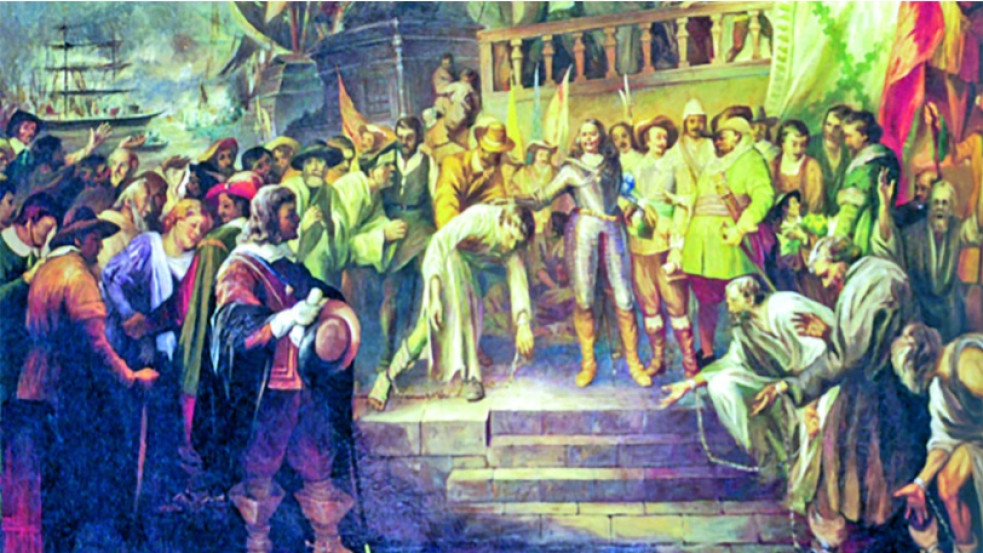
Otrokocsi Fóris Ferenc recalled the day of their release in his memoir: "On February 11, ... the Dutch fleet was heading toward the port of Naples. ... Around two in the afternoon, the shackles were removed from us, and until that evening, another galley opposite us was designated as our place of stay. ... Then we were called into the official room of the galley management, and there
our names were erased from that register of galley slaves—a book which we may rightly call the Book of Death.
... great and wonderful are the works of Almighty God, just and true are His ways, who protected His innocent servants from the rage and tyranny of the Beast."
In the history of Hungarian Protestantism, the struggle against the severe curtailment of the rights of the Hungarian National Assembly and the cause of Protestant religious freedom became intertwined. The Ceasefire Agreement of Vasvár (1664), which ended the Habsburg-Ottoman war and was unfavorable from a Hungarian perspective, triggered outrage across broad layers of society and culminated in an aristocratic conspiracy led by Palatine Ferenc Wesselényi.
Although Wesselényi died in 1667, his companions rebelled against Habsburg rule in 1670. The consequences of their failure were severe: the following year, Lord Chief Justice Ferenc Nádasdy, Péter Zrínyi, Ban of Croatia, and Ferenc Frangepán were executed, while the elected Prince of Transylvania, Ferenc Rákóczi I, was saved from this fate only by a ransom. The suppressed rebellion, which the court in Vienna interpreted as the Hungarian estates "forfeiting their rights" and being classified as subjects by force of arms, gave Leopold I the opportunity to extend absolutist rule and to proclaim the Hungarian Protestants as scapegoats—even though the rebel lords were Catholic and even enjoyed the support of certain Catholic prelates.
The ten years from the fall of the Wesselényi conspiracy to the National Assembly of Sopron (1671–1681) are rightly called the "decade of mourning" by Hungarian Protestant historiography, the negative climax of which was the show trials against Protestant ministers and teachers.
In the contemporary court of Vienna, two major factions struggled with each other. The ministerial party primarily sought to exploit the economic resources of the Kingdom of Hungary in accordance with Habsburg interests, while the clerical group's goal was the suppression of Protestantism. The fact that the "throne" and the "altar" did not shy away from physical violence was nothing new compared to the 16th-century history of Recatholicization, only the forms of violence expanded to include show trials. György Széchenyi, Bishop of Győr, had already formulated the scapegoat concept during the rebellion. In his letter dated May 20, 1670—excusing Péter Zrínyi and Ferenc Rákóczi I—he wrote:
"Those two poor men ... were deceived in the synagogue of the cursed heretics... Those who seduced them must be punished."
György Bársony, Bishop of Várad, in his work titled "Veritas toti mundo declarata" (Kassa, 1671), supplemented this idea by extending the "theory of forfeiture of rights" from the Hungarian estates to the Protestants: he believed that despite the laws enacting religious peace, the king was not obliged to tolerate Protestants because they had forfeited their right to exist through their (alleged) rebellion.
Waves of Show Trials Sources are available for five show trials between 1671 and 1674. The defendants were Hungarian, German, and Slavic-speaking Protestants. Among those summoned before the court sitting in Pozsony on January 3, 1671, were both nobles and ministers. Those among them who were still alive at the time of the sentencing were executed with extraordinary cruelty. The second tribunal was established on May 13, 1672, in Nagyszombat under the presidency of György Szelepcsényi, Archbishop of Esztergom. The goal was the destruction of the Pozsony congregation: 4 ministers, 1 chaplain, 21 women, and 39 men were held accountable on charges of treason. They were deprived of their freedom, and their churches and schools were taken away. Although the ministers chose emigration, there were those among them who informed foreign Protestants about what had happened to their brothers. Antal Reiser, already as a minister in Hamburg, set down his report, which was published in 1678.
The first mass trial grew out of these proceedings in 1673. Szelepcsényi summoned 31 Lutheran ministers from Upper Hungary, János Losonczi Farkas, a Reformed minister from Veszprém, and István Szenczi Fekete, the Lutheran bishop of Kőszeg, before the tribunal sitting in Pozsony on September 25, 1673. Although the latter two remained absent, all were accused of participating in the Wesselényi conspiracy, providing aid to fugitives, slandering Catholics, and desecrating their religious symbols.
They were sentenced to death, and then offered a reversal: they could live if they ceased their service or left the country. One among them converted to Catholicism, the elders resigned from their office, and the younger ones went into exile.
Their story was left to us by János Burius, who served in the German congregation in Korpona. His manuscript titled "Micae" was preserved in the Lutheran Lyceum in Sopron.
Chronologically, the fifth was the proceeding of the mixed court (iudicium compositum) at Szepesváralja on April 30, 1674, which, under the presidency of Bishop György Bársony and the Provost of Szepes, judged 41 ministers and teachers after a proof that "did not rely on concretes at all." Their story concluded with most of them fleeing abroad while their property was confiscated.
In the series of show trials, the most significant extraordinary tribunal began its operation on March 5, 1674. Szelepcsényi, as the national commissioner of justice, summoned nearly every Protestant minister and teacher of Royal Hungary before his special court (iudicium delegatum) in Pozsony. Of the approximately 700 accused, 284 Lutheran and 52 Reformed ministers and teachers complied with the summons.
The sources highlight that the members of the court "were the greatest enemies of the Protestants": besides Szelepcsényi, Bishops Széchenyi, Kollonits, Pálfy, and Sennyey, as well as Counts Forgách, Pálfy, Esterházy, Széchy, and Erdődy. Among them, the name of the Hungarian prelate of Croatian-Austrian origin, Lipót Kollonits, attracts special attention because he developed the plan for the reorganization of Hungary (Einrichtungswerk) in accordance with Viennese interests and the demand for Recatholicization. In the memoir of one of those put on trial, he noted:
"Woe to those whose enemies are their judges."
Szelepcsényi's signature and seal authenticated the Latin minutes of the procedure. From the document preserved in the Primal Archives of Esztergom, it can be seen that the prosecutor referred to anonymous denunciations and letters. However, they took care to maintain the appearance of legality, as the reports of the previous proceedings were already known in the Protestant world. The Protestant defendants were able and dared to turn the charge of rebellion back onto the former Primate, György Lippay, who, seeing treason in the acceptance of the Peace of Vasvár, had requested foreign aid. Szelepcsényi was reluctant to include the preachers' evidence in the minutes.
It is also noteworthy that the prosecution could not substantiate the charges regarding the political organizing of the Protestants. For example, they claimed that the Calvinist students of Pápa marched out to the field for the ceremonial reception of the rebels, while according to the testimony of Bálint Kocsi Csergő, the rector of Pápa, it was an old custom of the students to occasionally play sports in the open air. A legal problem was that the evidence was not presented individually; they rather stuck to the joint charge and imposed the death penalty on both those present and those who remained absent.
However, it was obvious that the mass execution of the innocent would turn even some of the Catholics against them, and the destruction of Protestant parishes had already been achieved. Therefore, "out of mercy," the sentence was commuted to life imprisonment in fortresses, and to avoid the punishment, three types of reversals were offered: they convert to Catholicism, leave the country, or resign from their positions. Due to imprisonment and torture, some died, several escaped, while others signed the bond. By March 1675, only 42 persisted in their faith.
"I confess that I have seriously abused my official position and participated in the conspiracy woven against the Emperor; according to the law, I pleaded guilty before the appointed judges, but I requested and received mercy from the Emperor to live in safety and peace in Hungary. In exchange for this mercy, however, I promise that I will never again hold worship services and will remain faithful. I will report every suspicious rebel to the royal governor or the Lord Lieutenant."
It caused Vienna no small amount of concern that the condemned men did not remain silent. In their petition to the monarch, they argued that they were suffering “not for rebellion, but for religion.” News of their plight reached the Netherlands, Switzerland, and the Protestant German principalities; indeed, in a Latin-language Apology, they explicitly sought help from the Calvinist and Lutheran peoples and their princes. As Sándor Payr puts it in his work *The Hungarian Protestant Galley Slaves* (1927): it is no coincidence that Leopold I wanted to clear his name. Thus, a Jesuit scholar responded with a separate indictment to the preachers’ defense (Extractus brevis, Tyrnaviae, 1675), and an attempt was also made to prove, through the reversals signed following earlier trials, that these pastors and teachers were also guilty.
The Protestants did not fail to respond: they published a 126-page defense written in Latin and German (Hungarische Praedicanten-Unschuld, 1675), and many sought protection from their former teachers.
Attending universities in the West was a common practice for both Hungarian Protestant churches. After their talented young people had exhausted the educational opportunities available at home and saved up enough money, they studied theology at German or Dutch universities, facing no small difficulties. Those who returned home not only enriched their local congregations with their knowledge of the Bible and teachings on natural law, but also integrated them into the “Body of Christ.” Their service was invaluable in terms of the development of Hungarian legal thought, and their network of connections paved the way to liberation in times of trouble.
The former teachers showed the letters of complaint to the Dutch States General. Effective action was hindered by the fact that an alliance against their common enemy, the French, was just taking shape between the Habsburgs and the Dutch state at that time; however, the Dutch ambassador in Vienna, Hamel Bruyninx, a committed Reformed Protestant, visited Hungary and subsequently reported in writing to the Dutch States General. This also played a role in the fact that the 41 prisoners still alive in March 1675 were driven via Trieste to Naples. The 30 confessors who survived the journey were sent to galleys as slaves.
Michiel Adriaenszoon de Ruyter began his career at the age of 11 as an apprentice sailmaker, but by 1640 he was already a rear admiral, and at the age of 66 he was appointed commander of the Dutch fleet. He was almost never seen to lose his temper. According to his biographer,
“he despised the great divisions among Christians, and … hated it when believers who thought differently were condemned and persecuted.”
De Ruyter was preparing for a naval battle against the French when he received orders from the Dutch Council of State: he sailed to the Viceroyalty of Naples and began negotiations with the viceroy on behalf of the galley slaves. Although the Netherlands agreed to pay a ransom for them, the money alone was not enough. Since de Ruyter was aware that in the fight against the French, which also served Naples’ interests, certain death awaited more than one of his sailors, he offered their lives in exchange for the 26 galley slaves who were still alive. On February 11, 1676, he took them aboard his ship. Although they could not yet return to their homeland at that time, they remained faithful to their faith and mission even during their exile.
As for de Ruyter, he died of fever a few days after the battle on April 22. It is unfortunate that his modern-day critics tend to view him as a supporter of the Dutch slave trade. As a postscript, in May 1676, the 41 captives who were still suffering in prisons in Austria and Hungary were also set free.
The Protestant community in Europe took a keen interest in these stories, and rightly so. In addition to the memoir by Ferenc Fóris of Otrokocsi, Bálint Csergő Kocsi’s work (“Narratio brevis de oppressa libertate ecclesiarum Hungaricarum”) circulated in manuscript form until Péter Bod published it in print in 1738 under the title “The Siege of the House Built on the Rock.” In it, one can read de Ruyter’s response to the former prisoners’ thanks: “There is no reason to be grateful; I was merely an instrument of God.”
Recent research confirms that the number of people who fled abroad during the period of the show trials was significantly higher than the 80 individuals who committed themselves to leaving Hungary in the aforementioned reversals. Only a small portion of the church intelligentsia appeared in the records of the galley slave trial, as many students—due to the expected persecution—did not return home from abroad in the first place, and the summons of teachers to court was not comprehensive. This is referenced, among other sources, in János Burius’s aforementioned memoir titled “Micae,” which lists 314 individuals who departed for Transylvania or German-speaking regions, or who remained at home after renouncing their faith.
However, the former galley slaves—after a temporary stay in Switzerland—set out for home in October 1677, and after 1681, when the Sopron National Assembly’s resolution declared all punishments and obligations imposed on the preachers null and void, some of the emigrants followed them. Most of them returned to service at home.
At the same time, in 1691, physical violence against Protestant schools and churches gained new momentum. Without further listing the peaceful and violent means employed for the sake of recatholization, let us conclude this overview by noting that this state-sponsored process did not end, but merely lost some of its intensity during the Reform Era, as evidenced by the fact that following the suppression of the War of Independence—with Protestants once again forced into the role of scapegoats—it gained new momentum in 1859. However, all this did not lead them to give up, but rather spurred them on to fight against political and religious oppression.
The differing responses to these charges sparked heated debates—not only among the convicted preachers but also among those not involved in the trials—about what constitutes the right decision in a situation of religious conviction.
Conversion to Catholicism was viewed as a denial of faith, but it was debatable whether emigration and resignation from office constituted a breach of the pastoral oath. György Lányi, who was himself among the condemned, believed that there are both bloody and bloodless forms of martyrdom: the emphasis lies not on the external circumstances of the ordeal, but on the believer’s inner motives.
Others put it this way: the crown of martyrdom is not earned through passive suffering and death, but through active deeds—their steadfastness, endurance, and profession of faith. Yet no one ever questioned that the preachers and teachers who were tortured and sold into galley slavery were heroes of the faith. May their memory be blessed.


_bff800a6.jpg)









Seres László: 9/11 és a „végtelen háború” mítosza
Véleménycikk »
Fékek és ellensúlyok nélkül: Miért kellenek korlátok a „jó embereknek” is?
A szubjektív hangulatok és a racionális érvek hiánya rossz tanácsadó az államszervezet átalakításánál »
A Pride titkolt eredete
A melegmozgalom programját évtizedekkel ezelőtt megírták »
Seres László: 9/11 és a „végtelen háború” mítosza
Véleménycikk »
Fékek és ellensúlyok nélkül: Miért kellenek korlátok a „jó embereknek” is?
A szubjektív hangulatok és a racionális érvek hiánya rossz tanácsadó az államszervezet átalakításánál »
A Pride titkolt eredete
A melegmozgalom programját évtizedekkel ezelőtt megírták »