
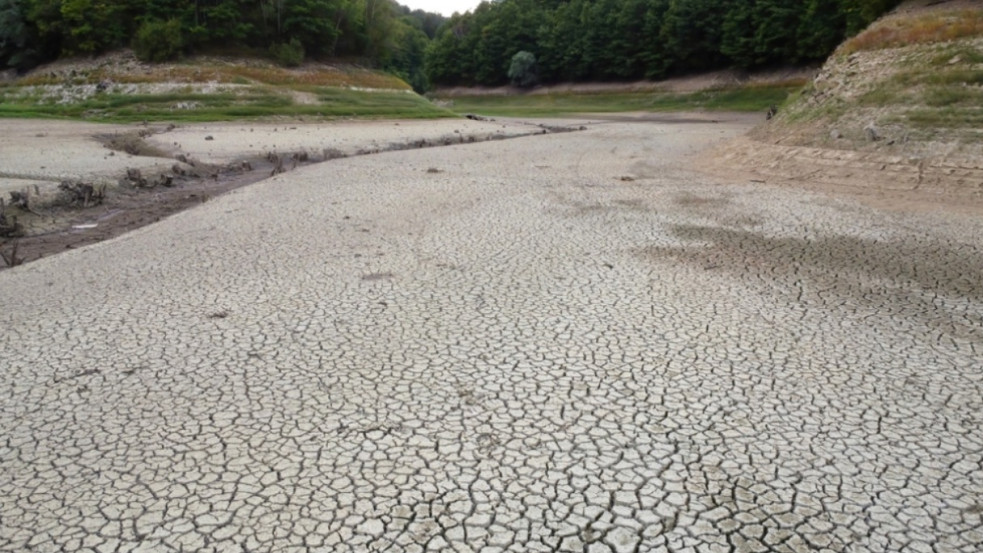
This is not a screenplay for a film set in a post-apocalyptic era depicting a dystopia, but the reality that Europeans, including Hungarians, have been encountering for weeks. In our article, we seek to answer what drought means in the Holy Scriptures, which form one of the bases of Western civilization, and we also look at what the Protestants' opinion was and what answers they gave in that era to the droughts afflicting their society, and thus themselves.
The Holy Scriptures speak of droughts and dry periods in several cases. These stories are well known. I would like to highlight two of them. One such is the seven lean years afflicting Egypt (and more broadly the entire region of the so-called Fertile Crescent), which, based on biblical chronology, can be placed around the middle of the 19th century BC. It is well known that one of the sons of the patriarch Jacob, Joseph, who was sold by his brothers, interpreted the Pharaoh's dreams about the seven years of plenty and the seven lean years. One description of the latter speaks of ears of grain "dried up by the east wind." This is a clear description of a dry period accompanied by drought, during which grain varieties considered basic foodstuffs for the people of that time (and today) will suffer severe damage. In other words, the harvest will be catastrophic, and moreover, for seven years. The consequence of this would have been general famine if Joseph, with the help of his talents received from the Almighty, had not worked out a program as a result of which the state does not consume, but instead stores the harvest of the years bringing abundance.
The other well-known story is that of the three-and-a-half-year drought that afflicted the northern Jewish kingdom of Israel in the 9th century BC, which had sunk into the worship of the pagan deities Baal and Asherah. The main character of the story is the prophet Elijah, whose prayer—according to the testimony of the Bible—triggered the drought, the result of which was intended to prove the helplessness of the fertility deities worshipped by the king and his family, as well as by the inhabitants of the kingdom. The solution to the problem was that the Jews had to do away with the Baal and Asherah cults, and later, as a result of the prophet's prayer, it started to rain again. The New Testament Epistle of James (written by Jesus' half-brother) sets Elijah's prayer as an example before Christians.
In many cases, the Holy Scriptures present droughts as judgment triggered by actions that go against divine law. King Solomon, in his prayer offered at the dedication of the Temple in Jerusalem (10th century BC), also highlights that if, during a time of drought, believers pray turning toward the Temple, then God should hear their request and put an end to the plague. The prophet Jeremiah (7th century BC) paints a very naturalistic picture of the drought period that befell the Kingdom of Judah due to idolatry, immorality, and social injustices.
Although in the Bible the cause of drought is primarily a judgment responding to ungodly deeds, at the same time, in several cases the plague (for the drought is that) can promote the realization of God's plan in the life of an individual or a group, or even a nation. Of course, this is true if the appropriate response comes from those affected. We can see this in the two highlighted examples as well. The seven lean years helped the reconciliation of Joseph and his brothers, and further persuaded Jacob, who lived in the land of Canaan, to move to Egypt with his family. In Elijah's story, a break—even if only for a very short time—occurred from the worship of foreign gods. In Jeremiah's time, however, there was no turning away from sins, so the drought was followed by even more severe judgments. In the last book of the New Testament (and the Bible), the Revelation of John the Apostle, we can read that the severe warming and drought afflicting our planet do not trigger self-examination and repentance in contemporaries, but rather the blasphemy of God. We can conclude that individuals and communities can respond to the plagues of droughts in two ways.
Throughout history, droughts have regularly occurred, dragging states, communities, and individuals into catastrophe. Peoples who did not know the Judeo-Christian revelation responded to these plagues in most cases with cultic practices. Fundamentally, they did not consider their own moral state to be the cause of the drought, but attributed it to the whims of the gods. In medieval traditional Christianity, droughts were already viewed differently. They recognized them as a divine response to sins. Despite this, they most often reacted with religious practices that had little to do with the declaration of the Holy Scriptures. These included self-tormenting and self-torturing ascetic practices, the carrying around of relics, or liturgical supplications addressed to various saints.
The Reformation, which began in 1517, sought to change this practice as well. Droughts and extreme dry periods were considered God's righteous judgment, a sign calling for repentance and conversion. In some cases, they were viewed as apocalyptic signs. In order to bring an end to natural disasters, they repented at the community level, fasted, and also prayed. In 1540, it did not rain for months, as a result of which several rivers (including the Elbe and the Rhine) dried up in Europe. Martin Luther considered this extreme drought to be God's righteous anger and a sign of the end times. It is clear from his conversations with his disciples and friends that he did not think of extreme weather changes as blind natural processes, but as events of deep spiritual content.
Starting from the Bible, he saw that Satan has an influence on the weather, and therefore he stands behind every natural disaster. Based on the Book of Job, he believed that these interventions occur with God's tacit approval, so their primary purpose is to remind people of the need for repentance. He also believed that the situation could be changed through sincere prayer: "When there is no rain and the drought is great, one should not look for sorcerers, but fall to one's knees and pray earnestly."
In the 16th and 17th centuries, there were droughts on numerous occasions in Hungary as well. Protestant preachers considered these, along with the Ottoman conquest, as divine punishment due to the "sins of the Hungarians," as Albert Szenczi Molnár put it. It is interesting to note that they saw the drought appearing in nature as a symbol of the people's spiritual and soulful emptiness and their turning away from God.
John Calvin interpreted the weather, and within it droughts, within the framework of God’s absolute sovereignty. In his opinion, "not a single drop of rain falls without the will of God," and therefore droughts also have a definite purpose. Firstly, the testing of believers and education through this, and secondly, droughts are punishments for people’s ingratitude. As the leading pastor of the city of Geneva, Calvin introduced official days of repentance and wrote prayers to be recited at these times. These days, during which they also fasted, were mandatory for every citizen of the city. Calvinists in Hungary practiced these as well. Numerous prayers have survived from 16th- and 17th-century Debrecen, which were recited in such situations.
The Puritans thought of themselves as a people in covenant with God. When they faced the fact that there was no precipitation and the lands were drying up, they saw in this evidence that the community had strayed from the right path, had become secularized, and had broken this covenant. They interpreted droughts primarily as a divine response to the collective sins of society (such as pride and ingratitude). Therefore, they proclaimed the so-called "Day of Humiliation and Fasting." On this day, an official public holiday was declared, when families woke up early and went to the meeting houses and church buildings dressed in black. There, they listened to sermons about repentance for hours, confessed their sins, and begged for God's mercy. They often did this with loud weeping. One of the most well-known such occasions was in 1623, when, by order of Governor William Bradford in New England, the believers gathered and prayed and pleaded with God for eight hours. Not primarily for rain, but for Him to cleanse their hearts. By evening, the sky had already become cloudy, and the next morning, after three months of drought, a gentle rain began to fall, which revived the fields and saved the harvest. As Jonathan Edwards also referred to it: for the Puritans, drought was a kind of spiritual alarm clock, a sign that it was time to put things right with God.
Pietism was a renewal movement within the Lutheran Church in the 17th and 18th centuries. Regarding natural disasters, they also professed that they were God's judgment. However, based on their optimistic eschatology, they believed that this plague created an opportunity for people to put things right with the Lord, thus preparing for the coming of the Messianic Golden Age. To this end, they organized prayers in private homes and small groups, in which they repented and asked for God's intervention in their lives and in the course of the weather. One of their representatives, August Hermann Francke living in Halle, preached the practice of active love. To this end, to alleviate the famines and rising prices resulting from the drought, they set up soup kitchens where the destitute could obtain food. In Hungary, Mátyás Bél represented this spirit. In the 18th century, under the influence of the drought afflicting Upper Hungary (Felvidék) and Transdanubia (Dunántúl), Lutheran pastors sympathizing with Pietism called on the faithful to abandon rigid religiosity and convert. To this they also linked practical assistance to the poor and disadvantaged.
Among 19th-century Protestants, a shift can be detected in the interpretation of natural disasters. They began to emphasize the existence of natural laws that also regulate the weather. They highlighted that humans must repent, but must also understand these laws. Social responsibility also received greater emphasis. The dust storms and drought of the 1930s in the United States resulted in pastors calling on the faithful for social responsibility and assistance, in addition to the traditional call for repentance. Alongside this, they also began emphasizing ecological responsibility. In today's Protestant theology, the "failure of stewardship obligation" also appears. This means that the Creator entrusted the planet to humanity, but humans neglected it and did not care for it. If you will, they forgot about the task received in Eden, they did not guard and did not cultivate the land well.
The question may arise: what can we do against drought today? In addition to natural activities (irrigation, responsible water management), what church history sets as an example before us is not negligible: self-examination, returning to God, and praying for rain.








Vége a zéró toleranciának? Iszlamista mártírkultusz és terror-PR Budapest utcáin
A terror normalizálása nem a fegyvereknél, hanem a szavaknál kezdődik »
Időzített bomba a Szaharában: Miért csak a jéghegy csúcsa a ceutai ostrom?
Ha a Száhel-övezetben rekedt milliók megindulnak Európa felé, a spanyol határon látott rohamok mindennapossá válhatnak »
Hitkísérlet: Modern Pascal-fogadás hódít a TikTokon
Egyre több nem hívő fiatal próbálja ki a keresztény életmódot – és sokan közülük tényleg megtalálják a hitet »




Fékek és ellensúlyok nélkül: Miért kellenek korlátok a „jó embereknek” is?
A szubjektív hangulatok és a racionális érvek hiánya rossz tanácsadó az államszervezet átalakításánál »
A Pride titkolt eredete
A melegmozgalom programját évtizedekkel ezelőtt megírták »
Pergamon ősi titka és Európa sorsa
Hogyan került a „Sátán oltára” Berlinbe? »
Fékek és ellensúlyok nélkül: Miért kellenek korlátok a „jó embereknek” is?
A szubjektív hangulatok és a racionális érvek hiánya rossz tanácsadó az államszervezet átalakításánál »
A Pride titkolt eredete
A melegmozgalom programját évtizedekkel ezelőtt megírták »
Pergamon ősi titka és Európa sorsa
Hogyan került a „Sátán oltára” Berlinbe? »