
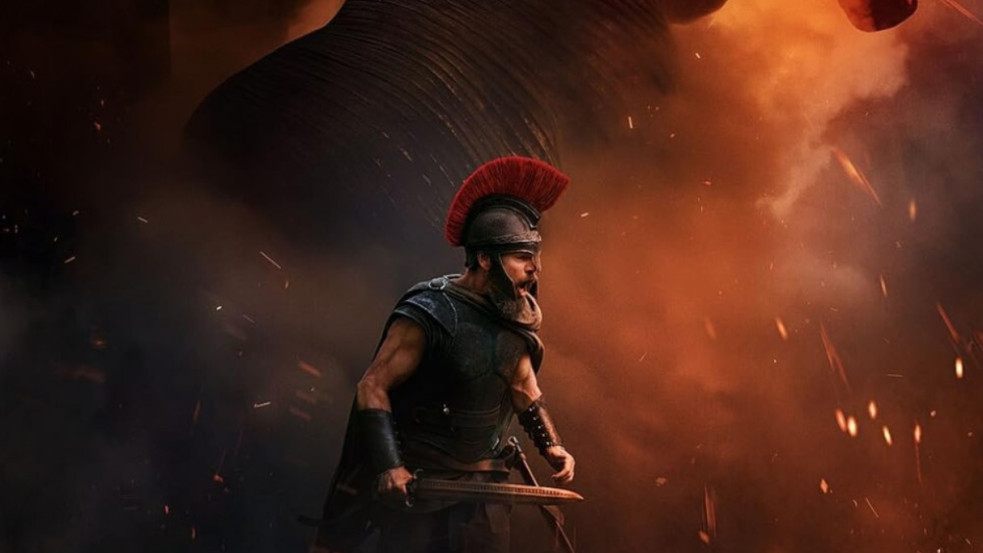
Classic works carry a great burden; adapting them is undoubtedly a difficult puzzle. On the one hand, it has its rewarding side: the brave director touches a guaranteed success story; at the same time, this is precisely what can cause the adaptation's downfall: transforming and bringing to life the favorite works and characters of millions is risky. For this very reason, it is not fair to demand completeness, especially in the case of grand-scale works. After all, who could bring the intricacies of Hugo, Tolstoy, or Dumas to the screen authentically and exhaustively?
That is why, in a film adaptation, the director must decide: to prioritize action (the plot, the sequence of events) or the heart (psychological elements). The former option may result in a spectacle film, while the latter can lead to an abstract art film. Christopher Nolan has become famous enough as a talented and experienced director that—despite all reservations and preliminary news—one receives a modern adaptation of Homer's epic with interest.
It is characteristic of Nolan, by the way, that he is capable of creating spectacular cinema while placing great emphasis on psychological elements. It must be admitted: the creation is visually stunning (filmed exclusively on real locations), monumental, and thought-provoking. It stands out particularly from today's cinematic offerings, and it is also refreshing because they were able to create it without sex scenes and other vulgar lustfulness.
Nonetheless, Nolan has taken shockingly great artistic liberty, to the extent that beyond the framework of the plot, Homer can only be detected in traces in the final product. As is usually the case with adaptations of classics, for those unfamiliar with the original work, every crumb of the original plot has the force of novelty, but this is not the director's merit.
The central motif of the film is a blown-up version of the Greek xenia (hospitality): it sneaks the basic principle into the Greek mythos as "Zeus's law" that "treat others as you would like them to treat you" (for you cannot know who is a god in human disguise). However, even though this principle is biblical, the way the screenplay applies it actually degrades this important spiritual guiding principle into a humanist parable.
The heroic motifs of Homer's heroes are all lost in the postmodern reading. Heroism covers evil, deceitful, and actually monstrous deeds! Odysseus does not even seem "resourceful" apart from the trick of the Trojan horse; and he certainly does not seem like an epic hero.
The guiding thread of the work is the local civilizations' fear of collapse. The reason for this dread is the migration of the Sea Peoples, who threaten the Greeks with erasure from the face of the earth. Naturally, Troy becomes the center of conflicts between civilizations; and for this, the film blends together the Iliad, the Odyssey, and Virgil's Aeneid. The episode of the Trojan horse and then the taking of the city is a graphic, spectacular unfolding toward the end of the film, precisely because this event is of key importance in the soul of Odysseus as imagined by Nolan.
For in the final outcome, it turns out: what man dreads so much (the "Sea Peoples" who threaten the civilizations of the Bronze Age) is actually himself: he is the destroyer, the demolisher, the greedy and desire-driven monster. Therefore, in the new adaptation, the Greeks invade Troy not because of a marital dispute (nor because of a rivalry among goddesses), but for the sake of seizing trade routes. One could say that the Odyssey gains an anti-colonial reading, whose contemporary overtones could be highly problematic.
Although the idea of human unscrupulousness and unbridled desire also appears in Homer, Nolan highlights this theme in an entirely different way, producing a dark-toned modern parable with a sharp edge of social criticism. His concept could fundamentally work, and it is indeed important to address this issue; however, in reality, the director himself has already fulfilled this task in his latest film about the grave dilemmas of the atomic bomb, Oppenheimer. In any case, Nolan is acting the pioneer in the field of apocalypse movies completely needlessly, as this is such a rich genre that has already produced its own parody subgenres. He can bring nothing new to this field; the overall effect is a three-hour pacifist manifesto.
From this point on, it is incomprehensible why he had to completely mislead the narrative of Homer's epochal work with these specifically postmodern dilemmas.
It is strange to see an apocalyptic expectation in a Greek origin myth (especially since the Greek worldview practically omitted any eschatological concept). Of course, it is not impossible to communicate the end already at the beginning—God also quickly "spoiled the punchline" (with the Protoevangelium), yet the unfolding that has been ongoing since then remains "exciting". Nolan too could have easily relied more on the heritage left by Homer. But the original epic is so hollowed out, and only the bare sequence of events is utilized (and even that arbitrarily), that in the end, the viewer familiar with the Homeric work is justified in asking the question: exactly why did Nolan want to adapt this classic in particular, if he holds its raw materials in such contempt?
Conservative analysts appreciate the idea in the film that violators of natural laws can expect catastrophes; at the same time, they forget that the original Odysseus does not suffer from this. Nor has his mental health deteriorated like that of so many 21st-century individuals, who, unlike the original Odysseus, mostly did not have to experience any war trauma. Matt Damon's Odysseus is a traumatized, guilt-ridden wreck, who is occasionally shown as perhaps not even wanting to return home anymore.
Homer's epic is the end product of an oral poetic tradition, where truth and the deeds of heroes are presented as objective facts within the world of the myth. There is good, there is evil, and there is even an intermediate, mixed-judgment character. In today's age, this does not prove sufficient in art. Myth-busting is the brainchild of realistic reconstruction (or rather, deconstruction?). Thus, Odysseus is placed in Nolan's natural habitat: the moral gray zone. Although Homer did not strive to make the protagonist appear perfect either, Nolan—just like in his famous Batman's Gotham City—pushes everyone down under the swamp.
The longed-for wife, Penelope, receives a hammy, bordering-on-feminist reading, thereby rendering the most fantastic wife character in world literature unsympathetic at certain points. Nolan visibly did not concern himself with her character; his focus is on darker characters. While the Phaeacians, the Lotus-eaters, and so many other stories along with their rich ethical teachings were omitted from the film, Nolan created a strange origin story for Antinous, since in Nolan's universe, the "villain" (the main antagonist) is usually at least as important as the protagonist. The story of the boorish suitor—though interesting—is unjustifiably lengthy, especially in light of how much of the original work ended up on the rubbish heap, just like Odysseus's abandoned dog in the film. Of course, if the main characters are suffocating in a moral gray zone, it is no wonder that the character of the villain must be further deepened relative to them.
The slaughter of the suitors is a dramatic climax in the film as well; however, numerous important elements and moral messages from these original books are lost, including the significance of long-suffering and tactics, or how Athena alters Odysseus's appearance under the banner of "appearances are deceptive". Those familiar with Homer should not expect much from the fight fought shoulder to shoulder by father and son either. We miss out on the intimate reunion of the long-suffering spouses, and the restoration of the palace and kingdom built around the olive tree.
From all this follows one of the greatest sins that can be committed against a Greek work: there is no catharsis. Unlike in Homer's work, Odysseus does not reclaim his throne but goes into voluntary exile with his wife, and his son, Telemachus, takes over the duties of ruling. Athena is not there to tell our hero: "Son of the gods (...) hold your hand!" In Nolan's films, there is never a real homecoming, only wandering, and he was unwilling to give up this motif even out of respect for Homer.
It seems superfluous to go into detail about the hysteria surrounding the casting. One can find plenty of problems with the film beyond how fittingly who was cast in what role. One could, of course, mention the character played by the transgender actor (Elliot Page instead of Ellen), who does not even appear in Homer and is borrowed instead from the Virgilian world. Many also objected to a Kenyan actress playing "the most beautiful woman in the world", the personal cause (or this time, the deceitful pretext) of the outbreak of the Trojan War: Helen. But these are not essential from the perspective of the work as a whole.
Nolan was obviously caught up in Oscar fever, and therefore we see more East Asian, Black, or indeed Nordic white faces in the film than Greek-looking ones. In fact, no Mediterranean, Greek-like character appears on screen! The casting is a bit like the Willkommenskultur of our era: eventually, the only one for whom no room (or funding, or work) is left is the one who does the welcoming in the name of diversity.
Whatever other issues arise regarding the casting, they are actually not the fault of the casting itself, but rather another conceptual offense against the original work. Namely, that virtually no supernatural being appears in the latest adaptation; and an Olympian god not at all. The extremely poorly played Athena appears for just a few frames to fix her sorrowful face or teary eyes on the protagonist. How surprised those who read Homer's work after the film will be (if indeed there will be such a mass)!
The Athena we see in this film is not the goddess weaving Odysseus's fate, but rather a projection, a personification of Odysseus's conscience based on a painful Trojan memory. Anyone encountering the story for the first time will not learn that the decisive characters of the work are actually the gods. However, Zeus appears this time only on an abstract, principled level, and the avenging sea god, Poseidon, who hunts Odysseus to death, is barely mentioned. There are no Olympians here, there is not even a deus ex machina, only man and his criminal past. Nolan excellently depicts the sadness and fateful drifting of the unredeemed man left alone with his sins, but he should have accomplished this with another work. After all, one of the fundamental motifs of the Odyssey is the struggling of man in a polytheistic worldview among divine forces.
In Nolan's creation, even the supernatural hidden behind the many forces of nature does not appear. There is no god of the winds, even though the encounter with Aeolus is an important moment of the epic. Charybdis, Scylla, and the Sirens are also rather passing metaphors for the difficulties of the sea voyage. Even more disturbing is that Circe is a lonely crone degraded to the level of a swamp witch, who seems to survive as a specter of the #metoo campaign: in her misandry, she sees the untamed consumer in every man, and therefore turns Odysseus's companions into pigs (in an unjustifiably disgusting scene of the film). We find no trace of Circe's original character, her role in the epic, and the relevant Homeric lesson (about the dangers of sexual temptation).
Calypso, instead of a sea nymph, resembles a woman suffering from a midlife crisis, who would rather ply her lover with gin than let him escape from her. Her residence, the island of Ogygia, resembles a hurricane-stricken Caribbean beach rather than that paradise where Odysseus's fidelity faltered for years. Nor is the protagonist freed from Calypso's captivity by Zeus and his messenger; instead, Calypso, turning into an impromptu psychologist, decides when to release her patient from the forced sanatorium.
Artistic freedom has thus taken such a wild detour that the director has wasted every single original character, historical thread, and lesson, while also being capable of banishing the gods from a mythological adaptation. Freely adapting Max Weber, we could say that he disenchanted the enchantment, demythologized the myth. Nolan openly embraces this: even the introductory text is this: "In the age of apparent magic..." His communicated worldview is, with the greatest goodwill, deistic, but rather infinitely humanist. In light of this, one of the most interesting scenes is when, before returning home, Odysseus must so to speak rely with faith on the seawater to bring him home. For the entire work did not provide enough invisible force to make it possible to speak of any faith whatsoever.
The director is so visibly repulsed by the supernatural that he ruins the famous journey to the underworld as well. Instead of the Homeric scene taking place in Hades (Nekyia—the descent into the underworld), we get a shamanistic scene with Germanic coloring; instead of an unexpected and tragic meeting with his mother who chose suicide, Odysseus can, among others, see the transgender soldier again before receiving the prophecy that guides him further on his path. Although the drinking of blood appears among the dead, the viewer does not understand its role: the souls of the dead are merely bodiless, rustling shadows (psyches) who wander aimlessly because they have lost their earthly memories and ability to speak. And this can only be temporarily restored by sacrificial blood—without understanding this, the viewer only gets a horrific scene.
The British director was unable to transcend his own cultural background: Greece's azure sea is regularly replaced by Albion's mists, and the Mediterranean feeling of life by Brontë-esque gloom. On the sea, they glide on Viking-style ships. The problem with this is that the world of Northern mythologies has already been depicted by better films, and grafting it onto the Greek context creates an inevitable stylistic clash.
This stylistic clash is reinforced by the soundtrack as well. The Icelandic composer's talent is unquestionable, but his work brings the shamanistic, spellbinding motifs of Northern peoples to the screen as accompaniment, which inevitably leaves its mark on the creation. The IMAX cinema experience in particular is overwhelming, almost putting viewers into a trance with its volume, and in this, Ludwig Göransson plays the role of the modern shaman. (I note that the already mesmerizing charisma of Nolan's films has assumed a completely new character since he started working with the Icelandic artist instead of Hans Zimmer, famous for music fitting epic settings.)
Only one element of the set of problems related to the film is that a director plagued by narcissistic tendencies has communicated his own soul to an excessive degree (and is so intolerant of contradiction that nowadays he is capable of attacking, one by one, critics who dare to express negative opinions), using Homer as a mere epic prop. For he cannot be held solely responsible for what happened in this adaptation.
One of the main culprits is the English language itself. English-language translations almost never manage to follow the original Greek hexameter meter accurately, and the vast majority of English translators do not even attempt it. The reason for this lies in the fundamental structural and rhythmic differences between the Greek and English languages. The most famous dactylic period, the hexameter, in Greek and Latin is based on the length (duration) of syllables: long (–) and short (∪) syllables alternate (quantitative verse). The English language is not duration-based, but stress- and accent-based.
We Hungarians have the advantage that our beautiful language (similarly to Greek) is excellent at quantitative verse because the length of vowels is clear, so Hungarian translations (outstandingly among these, that of Gábor Devecseri) follow the original melodiousness truly beautifully and naturally. English is forced into other (simpler) poetic forms, but several famous translations simply render the text as prose, which fundamentally alters the epic character.
We do not have the opportunity to plunge into the depths of the philosophy of language, but there is melody in language, and in melody dwells spirit. Thus, language decisively determines the character of a culture as well. From a linguistic perspective, the English language is more analytical and pragmatic, so its speakers also think differently than a Russian, a German, or a Hungarian. It is not by chance that English became the language of globalism, just as it did of superficial pop culture.
Why do we think that something was lost in translation? Because during the past weeks, people known as intellectuals were capable of making statements such as that in Homer's work there is no comprehensive thematic link, that it is full of "mere speeches, but the main point is that a man wants to get home". According to such commentators, Nolan merely penetrated into this narrative gap and provided a comprehensive message that was missing from the original. Well, this shows that the English-speaking audience did not understand something very fundamental about Homer.
In addition to all this, it should be highlighted that Nolan primarily turned to Emily Wilson's 2017 English translation for help in writing the screenplay. Although the director browsed through several translations and classical-philological works during preparation (such as the works of Robert Fagles or E. V. Rieu), by his own admission, Wilson's volume became his primary reference point.
This 2017 translation of the Odyssey is often labeled as "feminist" by critics and readers, while Wilson herself prefers to state that her work is not a rewriting of the text along a modern feminist ideology, but rather "clearing it of centuries of patriarchal distortions by previous translators". Her goal was thus to view the female characters "free of the male gaze". Given that negative bias and disadvantageous social discrimination against women were present both in the Greek world and in pre-20th-century English culture, the intention is understandable, but as usual, it swings to the other extreme by attempting to emphasize the deeply patriarchal and consequently oppressive nature of Homer's world. After all this, the only question is whether feminists are satisfied with the results of the redrawing of the female characters.
The spice of the situation is that Emily Wilson herself did not suppress her criticism after the film's release: although she was pleased with the sudden surge in book sales, she explained in several interviews and reviews that Nolan went too far in stripping down Odysseus, turning the cunning hero into a guilt-ridden Nolan-style action hero instead.
Yet the feminist-toned raw material definitely contributed to how Nolan gutted Homer's hero. The final result: instead of Greek philosophy containing, to a limited extent, the seeds of the Logos revealed in Holy Scripture, we get yet another didactic Anglo-Saxon product. Instead of a living, pulsating epic, we get a strange, shallow collection of anecdotes. Thus, after three hours, those in "possession" of the classical work inevitably cry out: "Tell me, Muse, of another man instead."








Vége a zéró toleranciának? Iszlamista mártírkultusz és terror-PR Budapest utcáin
A terror normalizálása nem a fegyvereknél, hanem a szavaknál kezdődik »
Időzített bomba a Szaharában: Miért csak a jéghegy csúcsa a ceutai ostrom?
Ha a Száhel-övezetben rekedt milliók megindulnak Európa felé, a spanyol határon látott rohamok mindennapossá válhatnak »
Hitkísérlet: Modern Pascal-fogadás hódít a TikTokon
Egyre több nem hívő fiatal próbálja ki a keresztény életmódot – és sokan közülük tényleg megtalálják a hitet »




Fékek és ellensúlyok nélkül: Miért kellenek korlátok a „jó embereknek” is?
A szubjektív hangulatok és a racionális érvek hiánya rossz tanácsadó az államszervezet átalakításánál »
A Pride titkolt eredete
A melegmozgalom programját évtizedekkel ezelőtt megírták »
Pergamon ősi titka és Európa sorsa
Hogyan került a „Sátán oltára” Berlinbe? »
Fékek és ellensúlyok nélkül: Miért kellenek korlátok a „jó embereknek” is?
A szubjektív hangulatok és a racionális érvek hiánya rossz tanácsadó az államszervezet átalakításánál »
A Pride titkolt eredete
A melegmozgalom programját évtizedekkel ezelőtt megírták »
Pergamon ősi titka és Európa sorsa
Hogyan került a „Sátán oltára” Berlinbe? »